
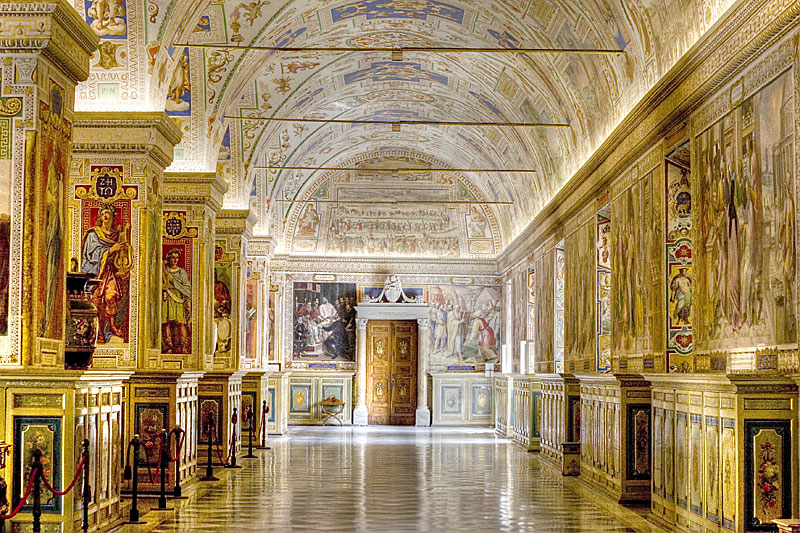
Vatican Museums
The Vatican Museums, founded by Pope Julius II in the sixteenth century, are one of the largest art collections in the world, exhibiting the collection of works of art accumulated by the popes over the centuries. In the museum visitors can also admire the Sistine Chapel and the papal apartments frescoed by Michelangelo and Raffaello.
First nucleus of the Vatican Museums was the collection of sculptures by Pope Julius II (1503-1513) placed in the “Courtyard of Statues”, today the Octagonal Courtyard.
The popes were among the first sovereigns who opened the public art collections of their building. In their form of artistic collections ordered in special buildings accessible to the public, the Museums and Pontifical Galleries originated by Clement XIV (1769-1774) and Pius VI (1775-1799) and therefore who set up these two popes named Museo Pio-Clementino. Pius VII (1800-1823) considerably expanded the collections of classical antiquities, Chiaramonti Museum and the New Wing also enriched the epigraphic collection housed in the Lapidary Gallery.
The museums host numerous collections, including: the Etruscan Museum founded by Gregory XVI (1831-1846) in 1837 with the finds from excavations in southern Etruria executed from 1828 onwards; the Egyptian Museum (1839), with the Egyptian monuments from explorations carried out in Egypt and with those who were already in the Vatican and in the Capitoline Museum; the Lateran Profane Museum (1844), with statues, bas-reliefs, mosaics from the Roman period that could not be adequately placed in the Vatican Palace and the Christian Museum, which includes ancient Christian sculptures, especially sarcophagi, and inscriptions, wanted by Pius IX (1846-1878) in 1854.
Since early 2000 the Vatican Museums welcome visitors with a spacious new entrance where there are reception services, enriched by different artworks, two of which were specially created.